Teaching
2026 Advanced Design of Interactive System
Janin Koch, Inria Lille
Advanced Design of Interactive Systems builds upon the Introductory Design course, but emphasizes on how to design interactive systems to support human-AI interaction.
About
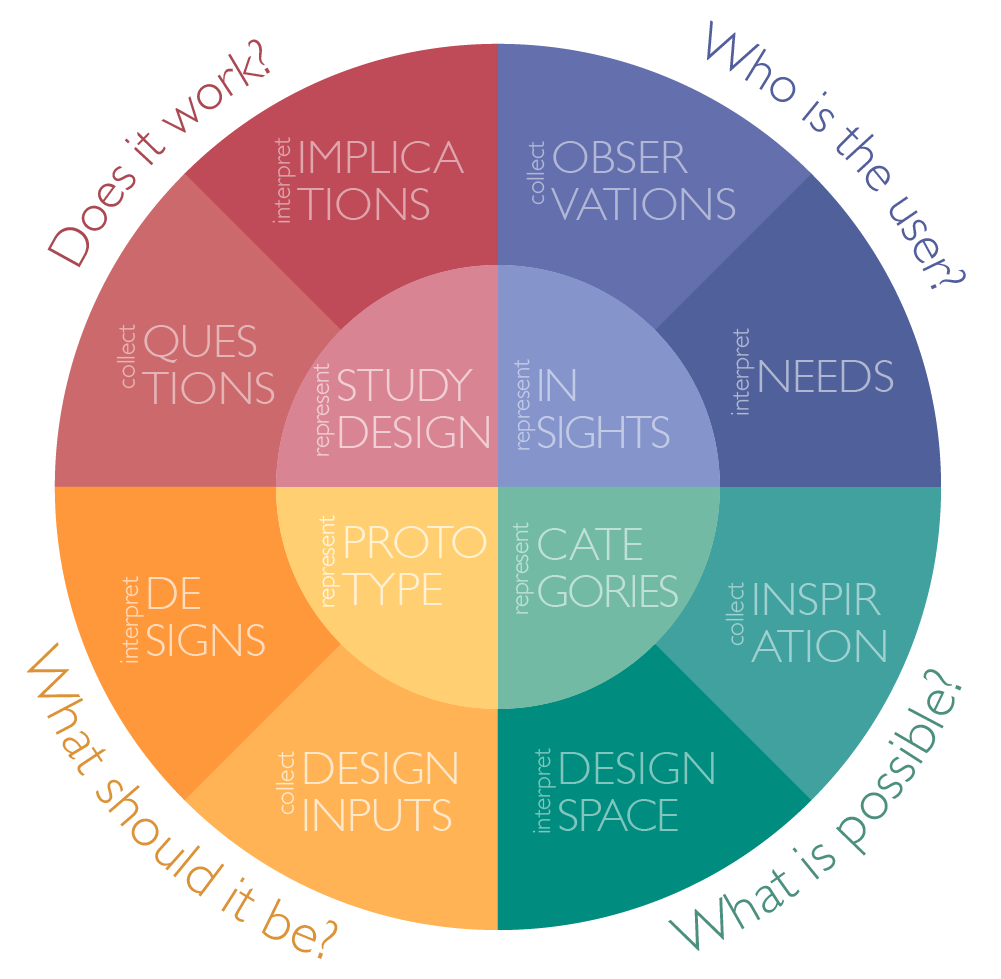
The Intro DOIT course is a prerequisite for the Advanced DOIT course. The former values speed and effective collaboration, while providing a quick overview of a complete set of interaction design methods. The latter builds upon the techniques in the introductory course, but explores in more depth human interaction as well as how to support interaction with intelligent systems.
Grading is based on your ability to identify key design problems from the user's perspective when interacting with generative systems, such as ChatGPT or DallE, and your creativity in generating a solution inspired by design principles, especially co-adaptation and instrumental interaction.
The class will be divided into groups of three or four. You will be asked to create a novel interactive system that is designed to support an extreme user of generative AI applications to provide more means for control and expression.
As in the Intro DOIT course, you will be asked to find out as much as you can about the problems users currently face, and then design and video prototype an original solution that addresses their needs. You will also revise it based on the results of a generative walkthrough.
Schedule
The course meets on Thursday afternoons from 13:30 to 17:00, room E212 in building PUIO, beginning on 7 January and ending on 26 February.
Note that students must be present for the final presentations on the last day of class.
Overview:
8 January : Introduction
15 January : Understanding Human Cognition
22 January : Agency in Human-AI Interaction
29 January : Iterating on Design
-- free week--
12 February : Evaluating Interactive Systems
19 February : Reflection on the role of design in Human-AI interaction
26 February : Final presentation
Lecture Slides
Course lectures and other relevant material will be updated here.
Lectures
Lecture 1: Introduction
*Exercise Lecture 1: Method Exercise
Lecture 2: Understanding Humans
Lecture 3: Understanding Agency
Lecture 4: Iterating on Design
Lecture 5: Evaluating interactive systems
Lecture 6: Reflection on HAI
Useful Links
Links to existing systems and GenAI models
Logistics
Please put your preferred email in this spreadsheet ASAP:
docs.google.com/spreadsheets/d/1ZIbpaKzJrZR0wYDORPa8KDIS2zPLQCm_yz-9xcApZ6I/edit?usp=sharing
Contact TA-Xiaohan Peng: xiaohan.peng@inria.fr
Get started with models
Here are some models that are either open-source or come with free tiers, feel free to try them!
Text-to-text
ChatGPT
Gemini
Llama
DeepSeek
Qwen
Kimi
Kimi K2 -- only as API
Coding specifically
Cursor
Github copilot (you can get pro tier with your university email account from Github Education)
Text-to-image
NOTE: For running models locally, you probably need >=16GB GPU to generate at a reasonable speed (e.g. a few secs).
ChatGPT
Stable Diffusion 3.5 Large
Stable Diffusion 1.5 with UI - run locally (and more customization!)
Stable Diffusion 1.5 with UI - run with online services
Selectable models with creative workflow UI - run locally:
ComfyUI
Invoke AI
Image-to-image
Recraft AI
Stable Diffusion (limited credits)
Text/Image-to-video
Runway ML (limited credits)
Stable Video Diffusion
Other open-source models
Hugging Face
How to try out open-source models on Hugging Face?